The 10 best marketing campaigns for finance companies of all time

Caleb Hinton
Mar 2, 2026
The 10 best marketing campaigns for finance companies of all time
Financial services are high‑stakes and trust‑sensitive, so standout marketing must build credibility while cutting through the noise.
In the 21st century, most financial decisions begin online. Without strong SEO, firms risk losing visibility and credibility. In fact, research shows organic search almost drives the majority of web traffic, roughly 46.98% by Shnoco’s 2025 data, and finance sites rely heavily on those results. Against this backdrop, the campaigns below – from fintech disruptors to established banks – took creative risks that paid off in awareness and engagement.
Each combined a clear message with novel execution (often guerrilla or social tactics) to humanise finance and spark conversation. For context: inbound leads generated by such content convert at about 14.6%, versus 1.7% for outbound methods, highlighting why smart content matters in finance. The following examples demonstrate how imaginative ideas (when backed by data and strategy) can make finance marketing truly memorable.
WePay’s ice block marketing stunt
Fintech startup WePay (acquired by FIS) went viral in 2010 by physically freezing cash in a 272kg ice block at a PayPal conference, dramatising a “frozen funds” complaint against a competitor. The guerrilla stunt was backed by a cheeky landing page (UnfreezeYourMoney.com), resonating with a tech audience.
According to WePay’s co-founder, this stunt tripled daily landing‑page conversions and drove a 300% jump in weekly site traffic (with sign‑ups up 225%). It's clear the spectacle directly boosted leads and buzz. By tying the stunt into their product message (“unfreeze your money”), WePay grabbed press attention and consumer interest far above a typical content campaign. This shows how bold, offline tactics (when aligned with a campaign narrative) can amplify reach and ROI.
Current’s subway takeover campaign
In 2021, US mobile banking app Current plastered New York subway cars with irreverent ads under the banner “What Do You Think We Are, A Bank?”. The ads lampooned big banks’ failings (“Banks: we’re here for you. Also banks: you owe us money for running out of money.”). Positioned as a fintech challenger, Current used meme‑style humour and pandemic‑relevant copy to highlight traditional banking frustrations.
This guerrilla OOH (out‑of‑home) campaign not only stood out on the streets of NYC but also educated commuters about the fintech’s value (it was one of the first apps to deliver pandemic stimulus payments). By meeting customers literally on their commute, Current turned everyday frustration into brand buzz. The campaign reinforced Current’s anti‑bank positioning in a way that a typical financial ad never could.
Wealthsimple’s 'Money Diaries' series
Canadian robo‑advisor Wealthsimple focused on relatable content marketing to demystify investing. Its “Money Diaries” campaign was a mini documentary series featuring celebrities like Aubrey Plaza and Mark Duplass discussing personal money struggles (sentiment: “Money is weird!”). Instead of a technical spiel, Wealthsimple told human stories about debt, wealth, and financial anxieties.
Each episode on YouTube and social media normalised the ups and downs of managing money, implicitly suggesting that even successful people need guidance. By “meeting people where they are,” Wealthsimple made finance feel less intimidating. The campaign generated high engagement (celebrities attracted their own followings) and positioned Wealthsimple as the empathetic helper. It’s a reminder that for finance companies, authenticity and storytelling can be as powerful as product features.
Klarna’s smo(o)oth dogg campaign
Swedish fintech Klarna became famous for quirky, celebrity‑driven ads. In one era, rapper Snoop Dogg became a minor shareholder, and Klarna launched the “Smoooth Dogg” payments campaign (with Snoop doubling as “Smoooth Dogg”).
Meanwhile, celebrity influencers like Bretman Rock and Celeste Barber starred in viral holiday videos, and actress Maya Rudolph headlined Klarna’s 2021 Super Bowl ad “Four Quarter‑Sized Cowboys.” All these stunts played up Klarna’s hip, irreverent brand voice. By funding big‑budget TV ads (Super Bowl) and edgy online spots alike, Klarna showed it could blend mainstream reach with internet virality. The combination of high-profile talent and on‑brand humour turned payment marketing into pop culture events. Klarna’s result: massive earned media and a reputation that “buy now, pay later” can be fun, not just functional.
American Express’s spent documentary
American Express took a long‑view approach with “Spent: Looking for Change”, a serious documentary (distributed on YouTube) rather than an ad. AmEx sponsored this film about financial hardship, highlighting that “one in four US households are not well served by the traditional banking system” (payday lenders charged ~10% of income in fees). The credit card company wasn’t directly selling its products in the film – it was raising awareness of financial inclusion.
This move built brand goodwill: AmEx even cited its own Walmart‑powered prepaid card as part of the solution. The documentary resonated widely, racking up over 12 million YouTube views. In other words, American Express used purpose-driven storytelling (and its media budget) to spark conversation about money and policy. This campaign demonstrates that, for legacy finance companies, aligning with social causes can humanise the brand and generate engagement beyond typical ads.
Monzo’s London bus campaign
In 2021, UK digital bank Monzo took its brand onto the streets with bright orange buses. Rather than a simple wrapped advert, Monzo gave the buses their own Twitter account and ran a user‑generated content contest. Passengers were encouraged to Photoshop the Monzo buses on social media; the bank then featured the best creations on the bus’s Twitter feed.
This gamified the campaign and made commuters part of the story. The result: a great PR story in tech media and a flood of funny, shareable images online. By “meeting people where they’re at,” Monzo turned public transport into a moving billboard and a social experiment. It reinforced Monzo’s image as playful and customer-centric, turning everyday scenes (a London bus) into a talking point.
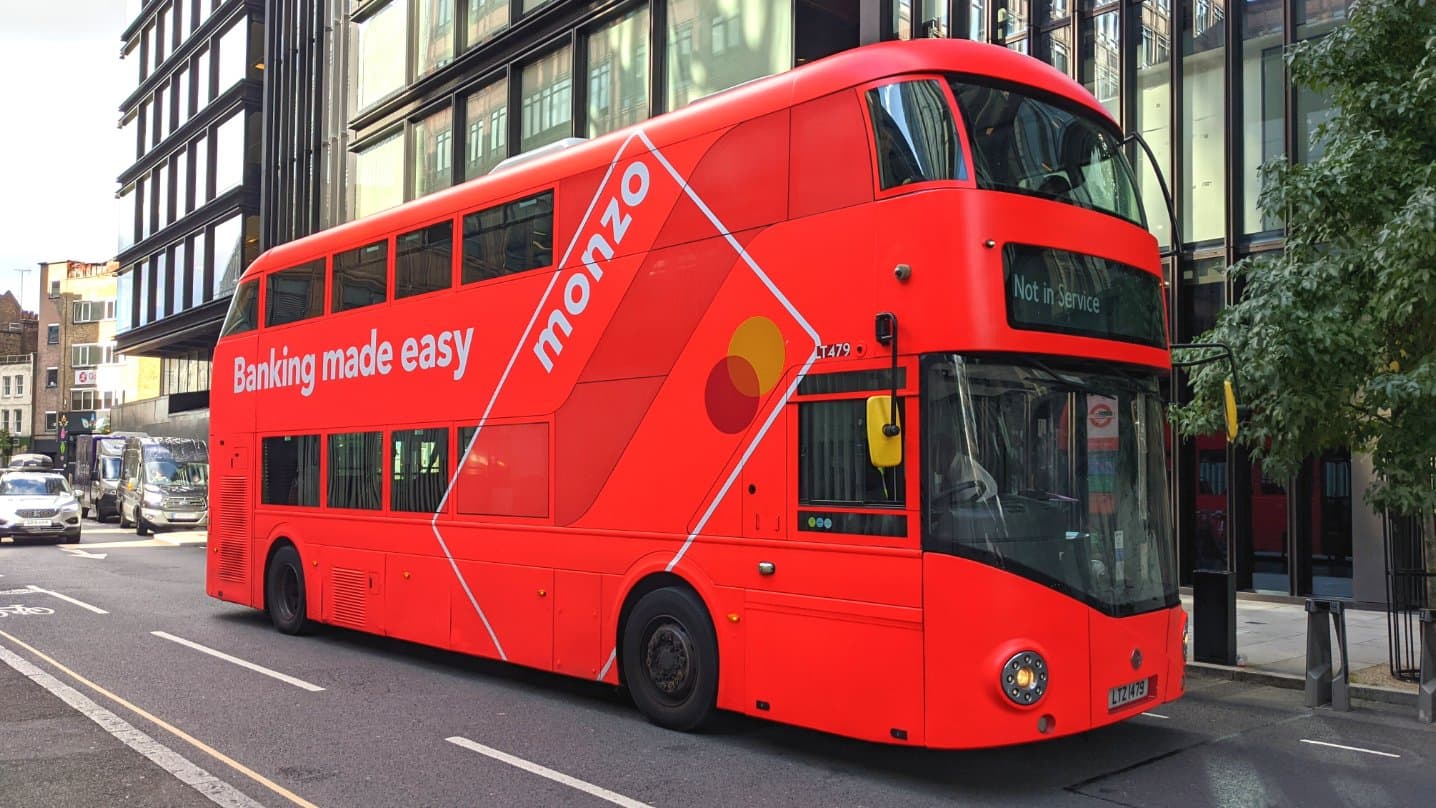
Monzo's Orange Bus Campaign in 2021 (image credit: Fintech Forum)
Moneysupermarket’s "Epic Strut" campaign
Comparison site Moneysupermarket (UK) made headlines with a hilarious US TV spot called “Epic Strut.” In it, a young man named Dave dances down a Los Angeles street while a narrator (his mum) explains how he saved money with their site. The lighthearted concept was a hit: in just five days it was shared 18,000 times and has now surpassed 1 million YouTube views.
Viewers loved the humour and memorable character (even writing fan tributes). As a result, Moneysupermarket’s brand awareness spiked internationally. The campaign works because it took a mundane subject (finding better deals) and delivered it through a catchy, funny story. It shows that even price‑comparison sites can win attention with a well-executed creative twist.
Nutmeg’s tube takeover campaign
UK robo‑advisor Nutmeg literally took out the London Underground. In 2015, it ran “Simplicity is the ultimate sophistication” ads on tube car panels and station cards across every line of the network. The total cost was only around £40–£50k – a steal for 24/7 exposure on each Tube carriage.
The campaign was timed to capitalise on the lack of WiFi underground (passengers look at ads). The tactics paid off in buzz: commuters snapped and shared the ads on social media, and Nutmeg won a FinTech Innovation Award for Marketing. By grabbing a captive audience in transit, Nutmeg dramatically boosted brand recall. It’s an example of clever offline placement for a digital finance service.
NAB’s honesty reward campaign
Australia’s National Australia Bank (NAB) rolled out a feel‑good social experiment. Hidden cameras in a shopping mall captured people “finding” dropped items (like sunglasses or a wallet). When a good Samaritan returned the item, the mall’s big screen lit up with their image and a congratulatory message. NAB rewarded everyday honesty by literally giving honour to honest customers.
The videos went instantly viral – viewers loved the uplifting experiment. This campaign didn’t push NAB’s products; it pushed an ethos. By linking honesty to its brand, NAB created a positive association and showed corporate character. It’s a reminder that finance companies can build trust through genuine values‑based marketing.
Making money “human”
These campaigns span institutions large and small, but each shares key principles. They turn abstract products into human stories, often by “speaking truth to power” (calling out traditional banks) or by infusing humour and humanity into money. Importantly, they align creativity with clear ROI – whether through media buzz or actual leads.
For example, studies show SEO in financial services has delivered over 1,031% ROI in recent years, underscoring how effective content-driven marketing can pay back many times over. In a sector where trust is everything, these creative campaigns attracted attention and reinforced credibility simultaneously.
Looking for SEO campaigns in the financial niche? At Finnus, we create organic financial content to help finance companies rank on Google and attract clicks.
The 10 best marketing campaigns for finance companies of all time
Financial services are high‑stakes and trust‑sensitive, so standout marketing must build credibility while cutting through the noise.
In the 21st century, most financial decisions begin online. Without strong SEO, firms risk losing visibility and credibility. In fact, research shows organic search almost drives the majority of web traffic, roughly 46.98% by Shnoco’s 2025 data, and finance sites rely heavily on those results. Against this backdrop, the campaigns below – from fintech disruptors to established banks – took creative risks that paid off in awareness and engagement.
Each combined a clear message with novel execution (often guerrilla or social tactics) to humanise finance and spark conversation. For context: inbound leads generated by such content convert at about 14.6%, versus 1.7% for outbound methods, highlighting why smart content matters in finance. The following examples demonstrate how imaginative ideas (when backed by data and strategy) can make finance marketing truly memorable.
WePay’s ice block marketing stunt
Fintech startup WePay (acquired by FIS) went viral in 2010 by physically freezing cash in a 272kg ice block at a PayPal conference, dramatising a “frozen funds” complaint against a competitor. The guerrilla stunt was backed by a cheeky landing page (UnfreezeYourMoney.com), resonating with a tech audience.
According to WePay’s co-founder, this stunt tripled daily landing‑page conversions and drove a 300% jump in weekly site traffic (with sign‑ups up 225%). It's clear the spectacle directly boosted leads and buzz. By tying the stunt into their product message (“unfreeze your money”), WePay grabbed press attention and consumer interest far above a typical content campaign. This shows how bold, offline tactics (when aligned with a campaign narrative) can amplify reach and ROI.
Current’s subway takeover campaign
In 2021, US mobile banking app Current plastered New York subway cars with irreverent ads under the banner “What Do You Think We Are, A Bank?”. The ads lampooned big banks’ failings (“Banks: we’re here for you. Also banks: you owe us money for running out of money.”). Positioned as a fintech challenger, Current used meme‑style humour and pandemic‑relevant copy to highlight traditional banking frustrations.
This guerrilla OOH (out‑of‑home) campaign not only stood out on the streets of NYC but also educated commuters about the fintech’s value (it was one of the first apps to deliver pandemic stimulus payments). By meeting customers literally on their commute, Current turned everyday frustration into brand buzz. The campaign reinforced Current’s anti‑bank positioning in a way that a typical financial ad never could.
Wealthsimple’s 'Money Diaries' series
Canadian robo‑advisor Wealthsimple focused on relatable content marketing to demystify investing. Its “Money Diaries” campaign was a mini documentary series featuring celebrities like Aubrey Plaza and Mark Duplass discussing personal money struggles (sentiment: “Money is weird!”). Instead of a technical spiel, Wealthsimple told human stories about debt, wealth, and financial anxieties.
Each episode on YouTube and social media normalised the ups and downs of managing money, implicitly suggesting that even successful people need guidance. By “meeting people where they are,” Wealthsimple made finance feel less intimidating. The campaign generated high engagement (celebrities attracted their own followings) and positioned Wealthsimple as the empathetic helper. It’s a reminder that for finance companies, authenticity and storytelling can be as powerful as product features.
Klarna’s smo(o)oth dogg campaign
Swedish fintech Klarna became famous for quirky, celebrity‑driven ads. In one era, rapper Snoop Dogg became a minor shareholder, and Klarna launched the “Smoooth Dogg” payments campaign (with Snoop doubling as “Smoooth Dogg”).
Meanwhile, celebrity influencers like Bretman Rock and Celeste Barber starred in viral holiday videos, and actress Maya Rudolph headlined Klarna’s 2021 Super Bowl ad “Four Quarter‑Sized Cowboys.” All these stunts played up Klarna’s hip, irreverent brand voice. By funding big‑budget TV ads (Super Bowl) and edgy online spots alike, Klarna showed it could blend mainstream reach with internet virality. The combination of high-profile talent and on‑brand humour turned payment marketing into pop culture events. Klarna’s result: massive earned media and a reputation that “buy now, pay later” can be fun, not just functional.
American Express’s spent documentary
American Express took a long‑view approach with “Spent: Looking for Change”, a serious documentary (distributed on YouTube) rather than an ad. AmEx sponsored this film about financial hardship, highlighting that “one in four US households are not well served by the traditional banking system” (payday lenders charged ~10% of income in fees). The credit card company wasn’t directly selling its products in the film – it was raising awareness of financial inclusion.
This move built brand goodwill: AmEx even cited its own Walmart‑powered prepaid card as part of the solution. The documentary resonated widely, racking up over 12 million YouTube views. In other words, American Express used purpose-driven storytelling (and its media budget) to spark conversation about money and policy. This campaign demonstrates that, for legacy finance companies, aligning with social causes can humanise the brand and generate engagement beyond typical ads.
Monzo’s London bus campaign
In 2021, UK digital bank Monzo took its brand onto the streets with bright orange buses. Rather than a simple wrapped advert, Monzo gave the buses their own Twitter account and ran a user‑generated content contest. Passengers were encouraged to Photoshop the Monzo buses on social media; the bank then featured the best creations on the bus’s Twitter feed.
This gamified the campaign and made commuters part of the story. The result: a great PR story in tech media and a flood of funny, shareable images online. By “meeting people where they’re at,” Monzo turned public transport into a moving billboard and a social experiment. It reinforced Monzo’s image as playful and customer-centric, turning everyday scenes (a London bus) into a talking point.

Monzo's Orange Bus Campaign in 2021 (image credit: Fintech Forum)
Moneysupermarket’s "Epic Strut" campaign
Comparison site Moneysupermarket (UK) made headlines with a hilarious US TV spot called “Epic Strut.” In it, a young man named Dave dances down a Los Angeles street while a narrator (his mum) explains how he saved money with their site. The lighthearted concept was a hit: in just five days it was shared 18,000 times and has now surpassed 1 million YouTube views.
Viewers loved the humour and memorable character (even writing fan tributes). As a result, Moneysupermarket’s brand awareness spiked internationally. The campaign works because it took a mundane subject (finding better deals) and delivered it through a catchy, funny story. It shows that even price‑comparison sites can win attention with a well-executed creative twist.
Nutmeg’s tube takeover campaign
UK robo‑advisor Nutmeg literally took out the London Underground. In 2015, it ran “Simplicity is the ultimate sophistication” ads on tube car panels and station cards across every line of the network. The total cost was only around £40–£50k – a steal for 24/7 exposure on each Tube carriage.
The campaign was timed to capitalise on the lack of WiFi underground (passengers look at ads). The tactics paid off in buzz: commuters snapped and shared the ads on social media, and Nutmeg won a FinTech Innovation Award for Marketing. By grabbing a captive audience in transit, Nutmeg dramatically boosted brand recall. It’s an example of clever offline placement for a digital finance service.
NAB’s honesty reward campaign
Australia’s National Australia Bank (NAB) rolled out a feel‑good social experiment. Hidden cameras in a shopping mall captured people “finding” dropped items (like sunglasses or a wallet). When a good Samaritan returned the item, the mall’s big screen lit up with their image and a congratulatory message. NAB rewarded everyday honesty by literally giving honour to honest customers.
The videos went instantly viral – viewers loved the uplifting experiment. This campaign didn’t push NAB’s products; it pushed an ethos. By linking honesty to its brand, NAB created a positive association and showed corporate character. It’s a reminder that finance companies can build trust through genuine values‑based marketing.
Making money “human”
These campaigns span institutions large and small, but each shares key principles. They turn abstract products into human stories, often by “speaking truth to power” (calling out traditional banks) or by infusing humour and humanity into money. Importantly, they align creativity with clear ROI – whether through media buzz or actual leads.
For example, studies show SEO in financial services has delivered over 1,031% ROI in recent years, underscoring how effective content-driven marketing can pay back many times over. In a sector where trust is everything, these creative campaigns attracted attention and reinforced credibility simultaneously.
Looking for SEO campaigns in the financial niche? At Finnus, we create organic financial content to help finance companies rank on Google and attract clicks.